
Wade Bridge of Whitebridge Trust
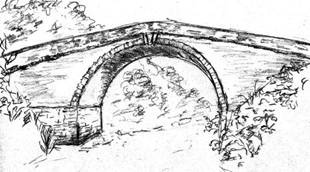
Whitebridge Wade Bridge Built in 1732
This historic bridge formed part of a strategic road system known as General Wade’s Military Roads. This network linking army garrisons was constructed in the early 18th century across the Highlands, in response to the threat from the Jacobites, who wanted James Stuart to replace Hanoverian King George.
The House of Stuart were former monarchs of Scotland, and also of England after the 1603 Union of the Crowns. They lasted, with gaps, through the 1707 Union of Parliaments until their lineage was broken in 1714 by the accession of King George. The Jacobites then led several unsuccessful uprisings.
General Wade’s report
King George was alarmed by a long letter from Lord Lovat (Simon Fraser) complaining about the unequal reactions to the Highlands Disarming Act from armed loyal and disloyal groups This prompted General Wade’s 1724 report of 10,000 men supporting the king, and 12,000 Jacobites. He advised making a network of roads and was given the commission.
The first road in 1725 ran from Inverness to Fort William through Whitebridge and Fort Augustus. An alternative lower road to avoid winter snow was constructed in 1732 with this 40ft bridge over the River Fechlin, the best surviving single arch of this period.
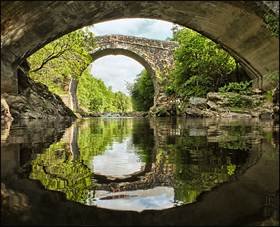
Photo by Russell Bain
Muckle Spate
In the great flood of 1829 local reports (repeated subsequently) described the arch and roadway being destroyed, but not the sides and parapets, with subsequent arch repair. The Wade Bridge of Whitebridge Trust believes there is no evidence in the underside of the bridge to support this history. The abutment facings are granite, probably rebuilt after erosion by the 1829 flood.
Scotland’s Military Roads
The final network covered 1,100 miles, of which the later 800 were directed by Major Caulfeild. Ironically they served a reverse function when used by the Highland Jacobites in 1745 to march as far south as Derby, before their final bloody defeat back north at the Battle of Culloden.
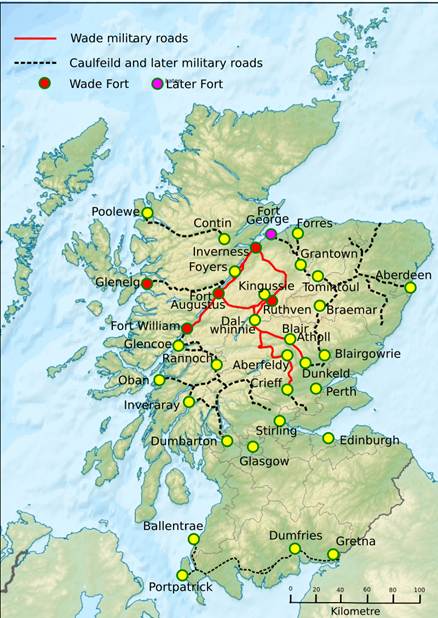
Other Wade Bridges
All three spans of River Spean High Bridge have collapsed. A signed access path leads from the Commando Memorial, north of Spean Bridge
The local Inverfarigaig bridge half-collapsed in 2010, despite added buttresses.
The five-arch Aberfeldy B846 Tay Bridge was built in 1733 to a design by architect William Adam. It survives with extensive repairs
Repairs
This bridge was used by road traffic until bypassed by the adjacent bridge in 1938. Pedestrian use continued until closure by Highland Council in 2007 due to deterioration
The Wade Bridge of Whitebridge Trust was established with Highland Council help. They arranged first-aid repairs with lime mortar and grouting to deter further abutment flood erosion and to stem parapet decay.
The bridge re-opened in 2011. June’s attractive Purple Fairy Foxglove re-established itself in the recessed pointing.
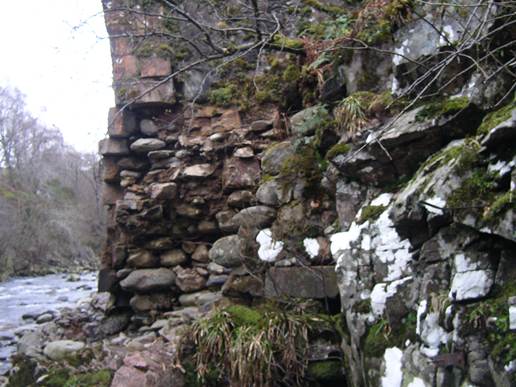
Eroded NW abutment in 2009
They carried out further repairs to the eroded NW abutment in 2022 with voluntary support. Both repairs had financial help from the Stratherrick and Foyers Community Trust.
The bridge remains fragile. Funding for full conservation is out of reach due to intractable ownership of the arch.
Saplings growing out of the bridge masonry are pruned back to deter bridge damage
Article about repairs in summer 2022 click here
Wade Bridge of Whitebridge Trust
Report on repair progress in 2010
A F Cruden Associates carried out a re-assessment of the bridge for the trust, funded by a Historic Scotland grant of £2,500. Their assessment was less harsh than the one by Mott MacDonald for Highland Council in 2008.
The trust failed in 2010 to obtain funding to match a 50% grant offer from Historic Scotland for the whole of the projected repair works, budgeted in phases totalling £250,000 including fees.
However the trust did achieve in 2010 a “first aid” project to establish access, pack the eroded abutment cobble backfill with natural hydraulic lime mortar, grout the abutments nearly up to springing level, repair the missing parapet stones, and do general pointing at the levels affected by the river. The work was carried out by Wildland Services, run by Brian Wilson, who had the all-round resourcefulness and conservation skills to tackle these challenging repairs. The work was directed voluntarily by Bob Main and John Townshend, civil engineers and trust directors. It was funded by a £7,500 donation from another trust director and by £9,000 from Stratherrick and Foyers Community Trust, plus other contributions taking the total to £18,000. The funding stretched to repairing the SE abutment nearly up to springing level, and this work was curtailed by high river flows.
The trust feels that the bridge is now reasonably secure against erosion by a major flood. Before the works there was a 1-in-1 year flood in June (causing no damage) with substantial upstream overtopping of the Foyers intake weir on the River Fechlin (see photos). After the works and probably in early 2011, there was a much higher flood evident from washing away of a temporary turf cap on the SE abutment repairs. This flood has caused no visible damage, but would probably have had a severe effect if the first aid works had not been carried out.
The trust has not yet tackled the eroded north-west abutment, the neglected superstructure or the missing voussoirs.
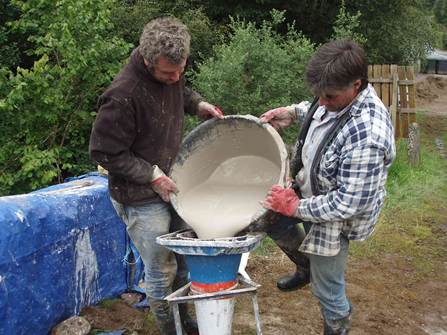
Grouting from roadway.
Background to setting up Wade Bridge of Whitebridge Trust
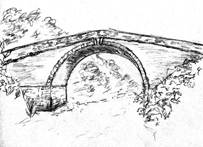
The Inverness Field Group tried since 2002 to get something done by Highland Council (HC) about the deteriorating condition of the 1732 Grade A listed arch bridge over the River Fechlin. In 2004 they asked the South Loch Ness Heritage Group (SLNHG) for help. The main stumbling block raised by HC was the extreme difficulty in ascertaining ownership.
In 2007 HC commissioned a condition survey by Mott MacDonald, consulting engineers, who said the bridge was on the point of catastrophic failure, recommended demolition, and HC immediately closed access to the bridge.
SLNHG published an article in the Boleskine Bulletin in Winter 2007 about the closure and asked for help. John Townshend (a civil engineer) searched for ownership details in Register House in Edinburgh, and wrote his own engineering assessment in March 2008 which was less pessimistic. SLNHG asked him to continue to help.
Margaret Davidson (HC councillor) took up the case vigorously after being buttonholed by Martyn Bateman of Stratherrick and Foyers Community Council (SFCC). She arranged a meeting on site in Mar 2008 including SLNHG’s Frank Ellam, John Townshend and Jason Hudson, owner of Wildside Holiday Lodges. She then arranged a meeting in Inverness in May 2008 between herself, John Duncan (HC Conservation Architect), John Addison and Kyrystina Pytasz (MottMac engineers), John Townshend and other HC officials. The meeting agreed on the urgent necessity of repairs.
The full MottMac report was not released until Sep 2008. Margaret Davidson convened a meeting at the Town Hall in Nov 2008 involving HC officials, John Townshend, Graeme Ambrose (SLNHG) and Martyn Bateman (SFCC). She said “I believe the only way this bridge will be restored is if it is led by the community and I am willing to put in the effort needed to help them with this if they so wish.” The meeting agreed to consider setting up a preservation trust involving members of SFCC and SLNHG.
SFCC arranged an open meeting at Whitebridge Hotel in Jan 2009 to explore the possibility of setting up a preservation trust. Iain Cameron (SLNHG) invited all members and interested people. John Townshend gave the presentation. 20 people attended and a support group was formed to take things forward. This group met in Mar 2009 and in April set up the incorporated trust. The directors were Martyn Bateman, David Murray (Whitebridge Hotel), John Townshend and later Bob Main. SLNHG chose Frank Ellam as their representative.
First aid to grout abutments and repair parapets was carried out in July to Sep 2010, funded by SFCT £9000, Martyn Bateman £7500 and donations £1700. This has saved the bridge during subsequent spates. More work in 2022 repaired critical voids in the NW abutment.