
Some time ago my father G.W. MacDonald (Teep) enquired about some of the local history of Killin and the surrounding area. This was in the nineteen sixties. The following article is result of his enquiries which, may be of some interest. Despite being in his mid-eighties, he learned basic computer skills and copied as much as he could from all of his gathered notes and letters, painstakingly typing them out document after document. This is one of those documents which relates to an enquiry to Lord Lovat in the mid nineteen sixties.
Duncan MacDonald.
MEMORIES OF AN OLD LADY.
Back in the sixties I wrote to Lord Lovat at Balblair House, Beauly asking for any historical records may have had in his archives relating to the Foyers and Stratherrick districts. Unfortunately, all the estate and family papers were burnt in the fire at Beaufort, which destroyed the entire library in 1936. He suggested getting in touch with his aunt in Morar, Mrs. Stirling O. B. E. which I did. This is her interesting reply; “Verbatim” (word for word)
Dear Mr. MacDonald,
I wish I could be more useful to you regarding the information you want, but I fear I have little claim to a very good memory, and my recollections are extremely ‘patchy’, and mostly connected with the period from about 1890 and 1910, when I married and lived in Perthshire, with only occasional visits to the north.
Knockie 1900-1901.
My brother, Lord Lovat rented the lodge and shooting for one or two seasons from the Grants and I imagine because this fitted in with letting the shooting and stalking of Glendoe or of Dell. Beaufort was always let during the summer, and my mother moved to Knockie with her household and family about this time, between 1890 and 1894.
Dell was let to my sister and brother-in-law (Hon. Bernard Constable Maxwell.) who spent the summer there. It was a charming lodge, the keeper was called Paterson, he and his family moved later to Beauly. The keeper at Knockie was called MacDonald; his daughter married Alex MacDonald of Whitebridge Hotel, known as ‘Sandy Whitebridge’, who drove a waggonette with two horses for hire. (A waggonette was a four-wheeled pleasure carriage, for six or eight persons on seats facing each other, often with a removable cover, drawn by one or more horses.) He was a very popular figure.

Whitebridge Hotel 1890c
The Postmistress, who also had a little shop, (At Whitebridge.) was also a friend; Mrs. MacDonald was I think her name. (Correct)
For many years we spent the summer months at Killin Lodge, from about 1894 until the lodge and part of the grouse ground was sold, and we moved to Stronelairg, which became a small estate surrounded by ground belonging to my brother who was glad to purchase it as it was a great convenience from every point of view. My brother used to shoot the grouse over dogs in August, and then the grouse were driven over the butts; and later there was stalking.
Owing to the high altitude of the ground, and the fact that we suffered from gales, mist and rain more than the adjacent moors, the sport was very unpredictable and variable.
I am not sure of the date when the Killin lodge was built; it was certainly older than most of the shooting lodges in the district, and I believe was built early in the 19th century
The present lodge at Stronelairg was built after the purchase of the property, I think about 1904 or 1905. The old lodge became the Keeper’s house

Stronelairg Lodge
The trout fishing in loch Killin was remarkably good. When we were at Killin we fished almost every day, and in two or three hours we usually caught a dozen or more trout. We also caught occasional char (Which, I believe, are called “Killiniensis”, a species peculiar to the loch) and in September we used to net very large quantities of char when they came, I think to spawn, near the shore in a bay on loch Killin. The fishing has deteriorated very much since about 1904, and this is hard to account for, though theories have been advanced to explain this undoubted fact.
Adam Ingles was the keeper at Killin and lived there with his wife and son and daughter. It must have been very stormy and desolate in the winter. I believe that the Aluminium works at Foyers were forced to close for a time in the summer for lack of water, (True) and some of the men there used to come to Stronelairg or to Kilin to act as “Beaters” for the grouse driving Stronelairg marched with Glendoe, and until my brother sold this property about 1905 or 1904, we sometimes spent the summer there.
Garrogie was occupied by the Buxtons, from Norfolk, during the summer when we were at Kilin.
Corriegarth was bought from Lord Lovat many years ago, I think early in the century, and I believe still belongs to the family who purchased it.
End of letter.
Knockie lodge was built in 1789, situated in the heart of the Great Glen. Sited on a sporting estate of over 5,500 acres. There are seven double bedrooms and two singles, all with hot and cold water and electric fires. The entire house is centrally heated and has five modern bathrooms. Private salmon fishing on Loch Ness, and trout fishing on six lochs and one river; there is also a pike loch. Opening April 1968. Proprietrix Mrs. R.G.M Cawthorne.

_____________________________________________________
Mrs. Stirling admits that she did not posses a very good memory, so she very kindly forwarded my letter to her sister Muriel, who was in St Vincent’s Nursing Clinic, Ladbroke Terrace, in London. Muriel’s memory is very good, her writing, not quite so good. This is her very interesting letter.
Dear Mr., MacDonald,
My sister has me your letter, as she says, I have a better memory. I certainly remember being at Knockie in the autumn of 1890 to 1891, especially the MacDonald family whose younger members were our contemporaries. (I was 6 years old)
My mother encouraged us to play with them, not so the old lady who “minded” us so greatly, resulted that my sister, who was three years my senior was much more often able to evade her attentions. The eldest boy Colin went to Australia as rabbit trapper.
To return to Beaufort, as many as possible packed into our waggonette and drove to Inverfarigaig; the rest of the household, myself included, walked by a path (which always was a right-of-way) down through the wood to Loch Ness, where we were met by a ferryman in an open row boat and put across to Temple Pier.
Knockie was rented for several years, later exchanged by the Grants for, — (this looks like ‘Fotherbeg’- i.e., Little Foyers) a part of the Lovat property adjoining their estate on the north side of Loch Ness. Of course, all Stratherrick was originally Fraser country, and at that time the Lovat property extended (with the exception of Garrogie) as far as Dell and Corriegarth.
I’m afraid we always regretted the sale of these properties, (mainly, I think because we knew and valued the peculiarities of the local inhabitants.) but my brother was always firmly convinced that it was better for the prosperity of the country that there would be more local land owners who would be there all the year round, not withstanding the fact that the sporting tenants brought large sums of money into the district, and the equally large rents they paid for their sport was the only thing that kept the property, with its enormous outlays, solvent.
Before the days of motors, the two-horse open waggonette, seating 6 to 8 people was the sole mode of local personal transport. Sandy Whitebridge had the monopoly in the district and had a wonderful pair of horses said to be capable of doing 100 miles a day, for which they were rewarded with seven feeds of corn in the 24 hours. Horses were tough in those days, and our own pair were capable of doing three trips to Inverfarigaig and back, twice in one day, a matter of sixty miles We did not use Foyers on account of the very steep hill, but even so, all except the driver and invalids were turned out to walk up the steeper hills.
When motors first came in, Sandy brought out all his horses and got my brother’s chauffeur, Danny MacDonald to drive up and down in front of them until they lost all fear of this monster. That was in 1902 or 1903, it was a little four-seater Packard which buzzed round at the great rate of 30 miles an hour. Danny was immensely proud that in those days of accidents and breakdowns, his car was always on the road.
I stayed for a short visit at Boleskine, it was let on a yearly lease to an old couple who left (or died) about 1895 when my brother lent it for a while to my mother’s sister and her husband, George Saul? Fox. I think it was sold not long after and they moved to Ardochy, Fort Augustus, which at that time belonged to the Abbey.
We spent nearly every autumn at Killin. It was the only place where my mother would let me go ‘bare foot.’ No self-respecting Highland school child would be seen in shoes and stockings after May, and the soles of our feet quickly became as hard as leather.
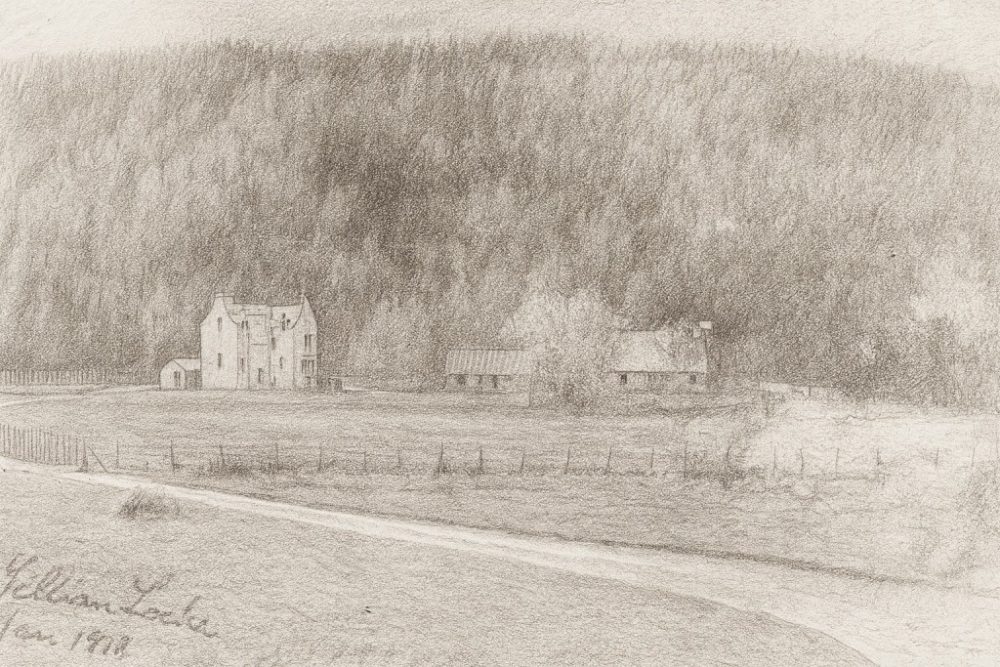
Killin Lodge 1912
The loch and river fishing was wonderful. I was with my eldest sister when she caught the biggest trout, over seven pounds. It put up a great fight, and with a small rod and light tackle, it took all her skill to land it.
The Aluminium Company’s first intention was to put a dam at this part of the loch and flood the whole valley, but could find only boulders and rubble and no firm rock for foundations, which was as well, as it gives pasture for great numbers of sheep.
Legend says that, Gory? the local giant, striding over the hills, stumbled and upset a great bowl of cream into the valley, hence it’s fertility.
Adam Ingles and his family were often isolated for weeks during the winter, and regularly got us a six week’s supply of provisions in November. His only son Bobby was killed in a shooting accident when out on the hill with tenants.
The Dell keeper Davey Paterson was—————His eldest son, born at Dell, became a priest, and as Monsignor Paterson, was for a time Rector of the Scots College in Prague.
Simon Campbell was the tenant at Dell farm, his sister was much loved. Mary Campbell was a ————————————-.Stronelairg was not taken over by my brother until about 1900.
Some years earlier, Ingles told us the gruesome story of a sad lunatic who was sent there with two keepers (in mid-winter) who neglected and ill-treated him. Once he escaped, and implored Adam to rescue him, but Adam did not know what to do and did nothing. Later the poor man committed suicide, which was just what his heirs had intended
The new lodge was built entirely from the granite boulders strewn over the hills since the ice age; they had to be carefully by Charlie Grant, a most capable stone mason from Fort Augustus, who was also a builder’s foreman. Stronelairg was of course, named after the pass leading from Stratherrick to Badenoch, and was patronized by travelers at that time, especially by my brothers coming north, who would leave the train at Kingussie and spend the first day of their holiday on a 30 mile trek through to—————-
On one occasion my second brother was not lucky. A blanket of mist came down at the —————–He had no compass and he decided his safest plan was to follow the downward course of a burn. He took one, apparently flowing due north, but after following its windings for 15 miles; at least, found himself back where he started, 2 miles from Kingussie.
In those days the ladies went out with the “Gillies” but never did any shooting themselves.
The first to do so arrived at Strone, not only with their own guns, but appeared at breakfast to everyone’s astonishment, in———breeches and misfitting jacket. (Breeches, a garment worn by men, covering the loins and thighs, and reaching just below the knees.) We were told the Gillies discussed whether they should be referred as “He” or “She” decided on.
Corriegarth was let on a long lease to the ———-until about 1908, where I remember well being there for a week, because it was the last holiday, I spent on the hill with my brother who was killed in 1914. After that I trained as a hospital nurse and joined the Sisters of Charity.
I think you will find that in the days of ‘Clearances’, there were very few evictions in Stratherrick. None certainly after my Grandfather inherited. He had a ——objection to sheep, but was very———-and a real pioneer in afforestation and during the potato famine gave all the work he could afford to the crofters in that direction.
He and my father evolved a system of “———–leases”, by which a crofter was given land at a nominal rent on a 20 years lease on condition that he brought all available land on his———-under cultivation. This greatly increased the amount of available land, and at the end of the term many crofters had achieved ‘Farmer’ status. They were then asked to pay a reasonable rent. This scheme was, unfortunately, misrepresented and denounced by certain agitators, with the result that it was prohibited by the Crofters Commission.
The accusation of having exploited his people so grieved and upset my father that my mother always claimed it contributed to his early illness and death in 1887.
During the 1890s agriculture was at such low ebb that, of my brother’s ———scheme for improvements were frustrated. He would have had now to reduce activities on the Beaufort farm if the sudden over-seas demand for pedigree stock had not come to the rescue. He saw that for the time being the only hope of more employment and more money coming into the country lay with the rich sporting tenants, so did all he could to improve the ———-amenities of the property.
I very much hope that some of this long screed may be of use to you and that I have not wasted your time (and mine!!) with it. If I can answer any more questions, please do not hesitate to ask.
Yours sincerely,
Sister———–
(Muriel Fraser.)
End of Letter.
_____________________________________________________
This is a description of Killin, and an eye witness account of the scene in this once famous “Shealing”; from the Edinburgh Geological Society XXXVII UPPER STRATHERRICK, WITH KILIN VALLEY AND TERRACES. By Thomas Wallace, F.G.S.E., Head Master, High School, Inverness. (Read 20th January 1887.)
Branching off from Stratherrick at Whitebridge, in a south-easterly direction, is the valley of Kilin. It is a narrow V-shaped glen, about seven miles long, and enclosed by hills of gneiss, who’s bare serrated peaks rise considerably over 2000 feet above sea level.
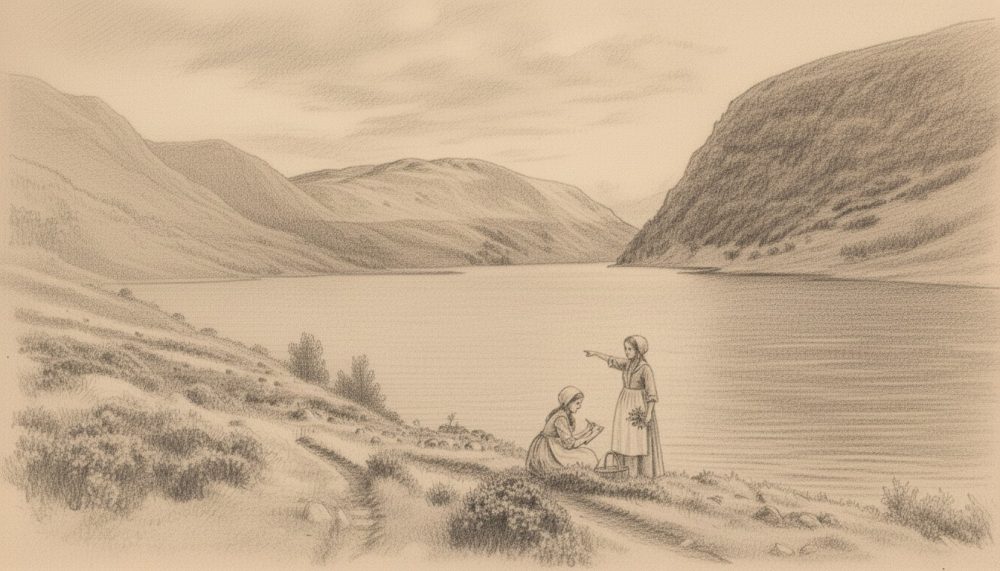
Loch Killin (artist impression)
Loch Killin, a small lake about one and a half miles long by a third to half a mile broad, occupies a deep hollow in the bottom of the upper part of this glen, with perpendicular walls of rock on either side, here and there dotted with birch and bracken and patches of young wood. The loch is fed by the river Killin, which is supplied by numerous tiny streams from the Monadh Leadh hills on the south-east of the glen, several which rise at a height above 2000 feet. From the loch the Fechlin flows through the glen, and falls into Loch Ness at Foyers At the south-east end of Loch Killin there is a flat of fertile land, about the same width as the lake, and about two and a half miles long. This flat was formerly one of the famous “Shealings”, to which the farmers in the lower parts of the country used to drive their cattle in the summer time for grazing, and to make their butter and cheese. This once lively and picturesque rural scene is thus described by an eye-witness;
“The surface of this flat is bedecked with the little huts or bothies, which afford temporary accommodation to those in charge of the cattle. Viewed from the top of a platform on the north-east side of the lake, fancy could scarcely picture a more attractive and fairy landscape than this sequestered vale, to which Dr. Johnson’s description of ‘the happy valley’ not inaptly applies. The milch cows, (a cow kept for milk) to the number of several hundreds, are generally kept there, from the beginning of June to the middle of August, when they are replaced by the yeld cattle. (Barren, not giving milk). In the little bothies, the young girls in charge of the milch cows pass their peaceful and secluded summers.
“The bothies are very primitive structures of turf, each of a single small apartment entered by a low doorway, from one side of which a breast-high turf screen, advanced a few feet, serves to protect the bed-place from the draught; and a bench of the same material along the opposite wall answers the purpose of chairs, and completes the arrangement of the interior, excepting that a small inner recess at one corner contains the dairy produce, which, we need hardly advise the thirsty way-farer, is here to be met with in perfection and with a welcome.”
_______________________________________
GW MacDonald (Teep).
Leave a Reply